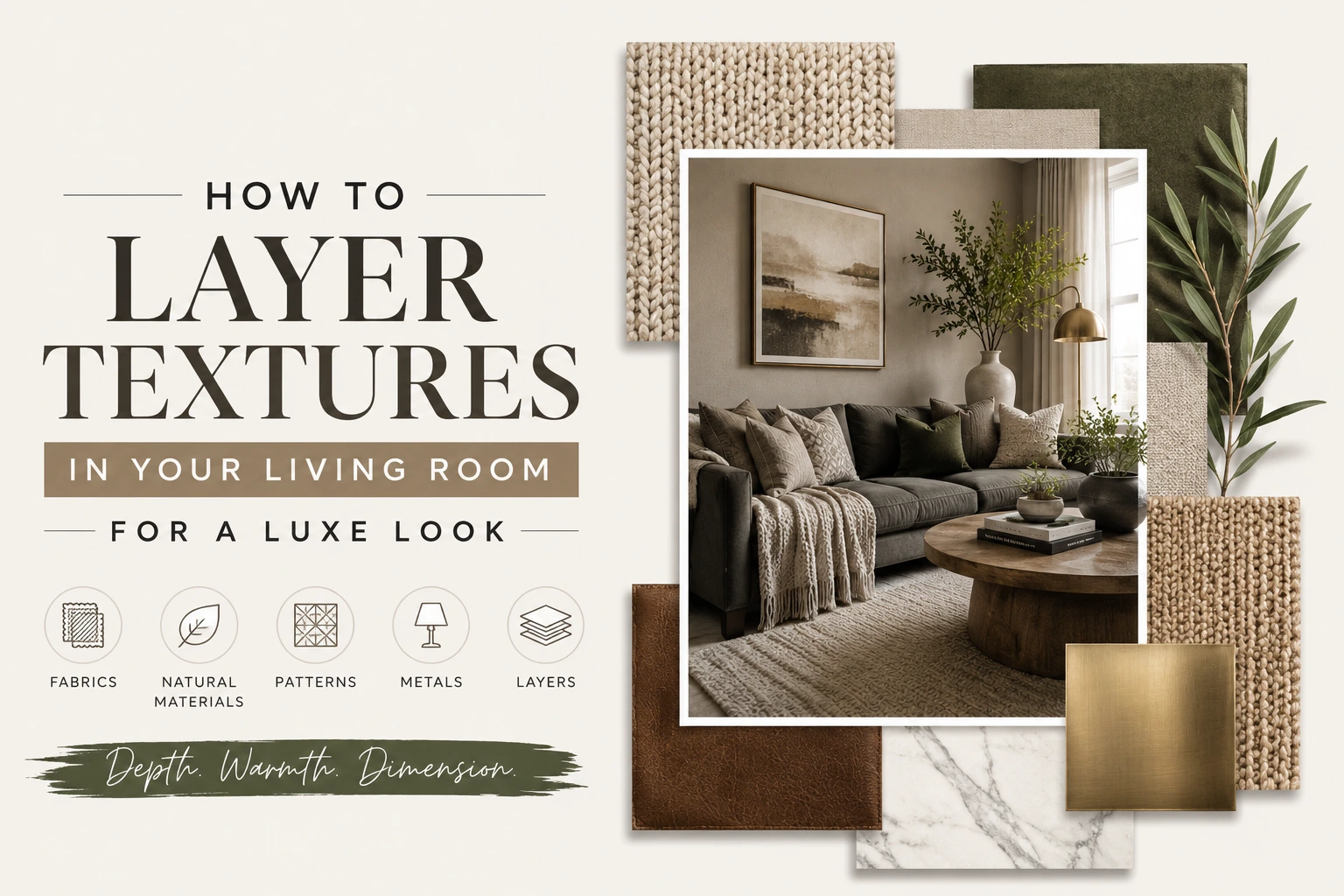
There is a quality that separates a genuinely beautiful living room from one that simply has nice furniture. Interior designers call it layering, the art of building up depth through the interplay of different materials, textures, and finishes until the room feels rich, warm, and dimensionally interesting.
Texture layering is the technique that explains why some neutral rooms feel extraordinary while others feel flat. It is what gives a room warmth on a visual level, the sense that there is always something more to discover the longer you look.
This guide teaches you exactly how to layer textures in your living room to create a look that feels genuinely luxurious — without a designer’s budget or a renovation.
Why Texture Matters More Than Color
Most people think of color as the primary tool of interior design. Color is important — but texture is more important, particularly in the living room.
Here is why: color creates impact. Texture creates atmosphere. Impact is what you notice on first glance. Atmosphere is what keeps you wanting to stay.
A room can have a stunning color palette but feel cold and uninviting because it is texturally flat, all smooth surfaces, all identical materials, nothing for the eye or hand to discover. By contrast, a room in the simplest neutral palette, all creams and natural linen tones, can feel deeply luxurious because every surface offers something different: a slightly rough weave here, a smooth glazed ceramic there, a soft nubby knit across the arm of the sofa.
The goal of texture layering is to create that sense of depth and discovery in your living room.
The Six Texture Categories to Layer
Think of textures in six broad categories, and aim to have at least four represented in your living room:
1. Woven / Textile textures: the visual and tactile complexity of woven fabrics: cotton weaves, linen, wool, jute, rattan. These are the foundation of any well-layered room.
2. Smooth / Reflective textures: glazed ceramics, polished metal, glass, lacquered wood. These surfaces reflect light and create visual contrast with matte or rough materials.
3. Natural / Organic textures: raw wood, stone, terracotta, dried botanicals. These ground the room with a connection to the natural world.
4. Soft / Plush textures: velvet, bouclé, fleece, fur. These are warmth-givers — used sparingly, they add tactile luxury without overwhelming the space.
5. Rough / Raw textures: exposed brick, unfinished concrete, raw linen, natural fiber matting. These add industrial or organic contrast to softer elements.
6. Layered / Pattern textures: woven patterns, embroidered details, geometric weaves. These add visual complexity even on a flat surface.
Building Your Texture Layers: Start From The Floor Up
The most effective approach to texture layering is to build from the ground up, starting with the largest surfaces and working toward the smaller details.
Layer 1: The Floor
Your area rug is the foundation of your living room’s texture story. A hand-woven natural fiber rug, jute, cotton, or wool. Introduces the first and most important texture layer. It also sets the warmth level for everything above it. A flat-weave cotton rug in a natural tone creates a quiet, organic base that allows other textures to build on top of it.
Layer 2: Large Upholstery
Your sofa’s fabric is the second major texture layer. Linen is the most versatile for layering because its slightly rough, organic weave contrasts beautifully with both the smoother surfaces above and the natural fiber rug below. If your sofa is a smooth velvet or leather, you have more work to do with the pillows and throws to introduce softer, more complex textures.
Layer 3: Throw Pillows
This is where texture layering becomes most deliberate. Your pillow arrangement should include at least three different textures, one woven, one smooth, one tactile. A handwoven cotton cover next to a linen cover next to a velvet accent cover creates a composition that is visually and tactilely rich.
This is also where handmade pieces make the most difference. A machine-woven pillow cover has a perfectly uniform surface. A handwoven cover has slight variations in the weave, small irregularities that catch the light differently and give the surface a living quality that makes the eye want to linger.
Layer 4: Throws and Blankets
A throw draped over the sofa arm adds a fifth or sixth texture depending on what you choose. A loosely knit throw, a lightweight woven cotton blanket, or a soft sherpa piece each contributes something different. The key is draping rather than folding — a naturally draped throw reads as lived-in luxury, while a perfectly folded one reads as hotel room.
Layer 5: Hard Surfaces
Coffee tables, side tables, and shelving introduce hard texture contrasts. A raw wood coffee table against the softness of woven pillows and a natural fiber rug creates exactly the kind of contrast that makes both elements look better. Add a ceramic bowl, a stone candle holder, or a glass vase and you have covered the smooth, natural, and reflective texture categories in a single surface grouping.
Layer 6: The Details
The final layer — and often the most memorable — is in the small details. A dried botanicals arrangement in a terracotta pot. A rattan tray on the coffee table. A stack of linen-covered books. A small woven basket holding throws. These are the finishing touches that make a room feel genuinely complete.
Common Texture Layering Mistakes
Using only one material family: An all-linen living room — linen sofa, linen pillows, linen curtains — is texturally flat despite being a single beautiful material. Always mix material families.
Avoiding contrast: Beautiful texture layering requires contrast. Soft needs hard. Rough needs smooth. Woven needs polished. Without contrast, the layers blend into each other and the depth disappears.
Ignoring the floor: Many people focus entirely on the sofa and neglect the floor, which is the largest texture surface in the room. A natural fiber area rug is the single most impactful texture addition you can make.
Over-plush: A room full of bouclé, velvet, and fur reads as maximally soft — visually heavy and lacking the contrast that makes texture interesting. Balance soft with rough and smooth for the most satisfying result.
The Natural Fiber Advantage
If there is one material family that contributes more to successful texture layering than any other, it is natural fiber textiles. Handwoven cotton, linen, jute, and wool all have inherent surface complexity — the organic variation of natural fiber weaving — that creates more visual interest than any synthetic equivalent.
At FIA Weavers, our handmade pillow covers, table runners, placemats, and area rugs are crafted from natural fibers using traditional weaving techniques. Every piece adds a layer of genuine material richness to your living room — the kind of texture that comes from craft rather than manufacturing.
Final Thoughts
Texture layering is the interior design skill that elevates a room from decorated to designed. Build from the floor up. Represent at least four texture categories. Contrast soft with rough, smooth with woven, natural with polished. Let your handmade textiles carry the most important layers.
The result will be a living room that looks different every time the light changes — rich, warm, and genuinely luxurious in the truest sense of the word.